 Rami Geffner, M.D.
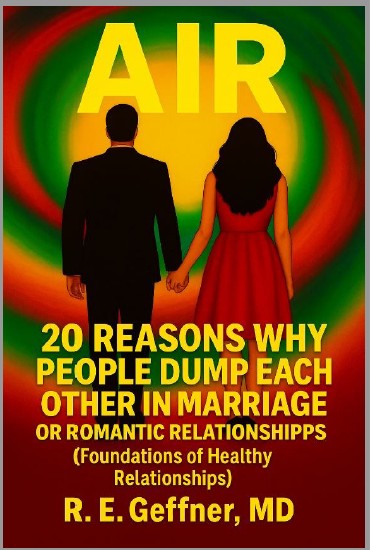
Excerpts from 20 Reasons Why People Dump Each Other in Marriage
We live in a world that celebrates falling in love but rarely teaches us how to stay in love. We learn to chase passion but not patience, to win arguments but not understanding, to repair crises but not prevent them. We call it normal when love fades, when couples drift apart, when laughter disappears from dinner tables. But what if it doesn’t have to be normal? What if we could learn to see the early signs, the emotional cracks, and fix them before they break us?
Love rarely ends with a bang; it fades in whispers. It fades in the sighs we ignore. We justify the distance and the tiny betrayals of attention, and we actually convince ourselves it doesn’t matter when it truly does.
This book isn’t about blame, it’s about awareness. It’s about catching the cracks before they become canyons.
The 20 reasons why women and men leave each other are not secrets. They are patterns we live every day, quietly, habitually, and often unconsciously, until love begins to starve for the attention it once effortlessly received.
That first step begins with A.I.R.:
Awareness — seeing clearly the reality of your relationship, not the fantasy, not the memory, and not the story you wish it were. Awareness is honesty without denial, defensiveness, or excuses. It is recognizing what is happening emotionally, behaviorally, and spiritually right now.
Intention — choosing to move toward healing instead of reacting from fear, ego, or pride. Intention means you act with honesty, humility, and care. You step away from blame, scorekeeping, and punishment, and step into responsibility, compassion, and understanding.
Repair — the courageous practice of fixing what has been hurt, broken, or neglected.
Repair does not mean perfection.
It means restoring connection, rebuilding trust, and improving how we treat ourselves and each other. Owning our part without minimizing or defending, apologizing without resentment or conditions, changing behaviors instead of repeating them, choosing closeness over silence, and growth over stubbornness.
Some relationships end not because love disappears, but because understanding does.
When empathy fades, affection becomes hollow, gestures without warmth, words without resonance. The body remains, but the heart goes quiet. Empathy is what makes love feel alive. It’s the ability to stand inside another person’s world, not to fix it, but to feel it. When one partner stops trying to understand, the other begins to feel profoundly alone, even when physically together.
When one person stays silent to protect the other, both end up alone. The truth might sting for a moment, but silence stings forever. Because every time you avoid saying what matters, you teach your partner that your heart is closed.
Affection isn’t limited to grand gestures, it’s the warmth in a glance, the softness in a tone, the reassurance in simple words like “I appreciate you” or “I’m glad you’re here.” Without these signals, even strong relationships start to feel transactional rather than emotional. One partner feels unseen, while the other may not even realize how their quiet neglect is being interpreted as indifference.
Repair isn’t about being right, it’s about returning. It’s the ritual of saying, “We fought, but we’re still us.” When that ritual disappears, distance replaces safety, and every conflict becomes another crack in the foundation of trust.
Most couples who struggle are not “bad people.” They are overwhelmed, exhausted, and well-intentioned people who never learned how to articulate what is happening between them.
Once the patterns are in place, one can begin to see that the true enemy is not your partner, it is the distance that grows when no one knows how to come back.
Every couple, at some point, stops paying attention, stops speaking honestly, stops reaching for each other, or stops growing. These are not signs of failure; they are signs of being human.